Why Your Skin Reacts More to Training in Late August
Quick Answer: Training-related skin problems peak at the end of August because a summer of sun exposure has compromised the barrier, and a compromised barrier reacts more to sweat, friction and heat. At the same time, falling humidity means sweat evaporates faster and leaves more salt residue on the skin, which is directly irritating. And increased sebum from a hot summer, combined with occlusive sunscreen and heavier fabrics, produces the classic late-season pattern of chest and back breakouts. The response is barrier repair, faster post-session cleansing, and a look at what you are wearing.
The post-workout redness that used to fade in ten minutes now takes an hour. There are breakouts along the jaw and across the back that were not a problem in June. The same face wash that has been fine all year now stings.
These are related, and they trace back to the same few weeks of summer.
This is general information, not medical advice.

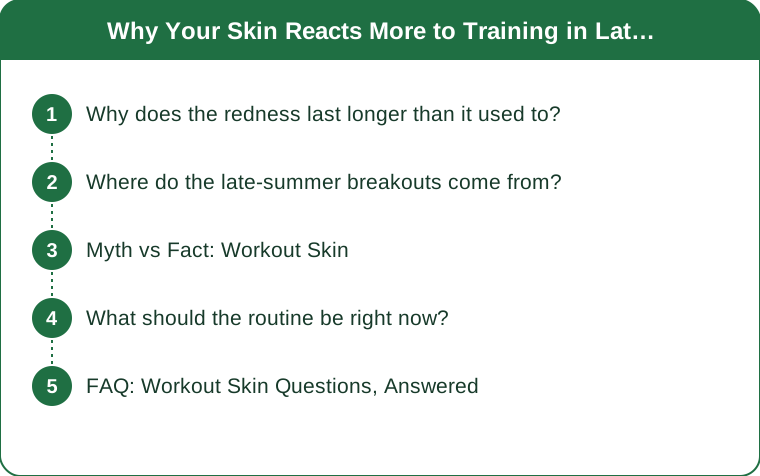
Why does the redness last longer than it used to?
Because the barrier is compromised and the vascular response is exaggerated on damaged skin.
Exercise raises core temperature, and the body responds by dilating the skin capillaries to dump heat. That flush is normal and should settle within roughly ten to twenty minutes of finishing.
On sun-damaged skin, it does not settle as quickly. UV exposure degrades the collagen supporting the capillary walls and causes lasting changes to vascular reactivity, so the same flush is both more pronounced and slower to resolve.
There is also a barrier component. A compromised barrier means more transepidermal water loss and more inflammatory signaling, so a normal thermal flush layers on top of low-grade existing inflammation.
If the redness is accompanied by heat, stinging or a burning feeling, that is a barrier signal rather than a circulation one, and it is worth taking seriously - continuing a strong active routine on skin in that state extends the problem for weeks.
Cooling helps directly. A cool - not cold - rinse after training, and finishing the session with five minutes of genuine cooldown rather than stopping abruptly, both reduce how long the flush persists. Stopping suddenly while still hot keeps the skin vasodilated longer.
Persistent facial redness that does not resolve, particularly with visible vessels or bumps, is worth a dermatologist’s opinion - rosacea is commonly triggered by both heat and exercise and it is frequently mistaken for exercise flush.
Where do the late-summer breakouts come from?
A combination of sweat left on the skin, occlusion, and friction - and the location tells you which.
Jaw and lower face is most commonly a combination of sweat, hands and equipment contact. Chest and back is usually occlusion - sweat trapped under fabric.
The mechanism is not sweat itself, which is largely water and salt. The problem is sweat sitting on the skin, mixing with sebum and sunscreen, and being held against the skin by fabric. That combination creates the environment for follicular occlusion and for bacterial overgrowth.
A hot summer raises the input on both sides. Sebum production increases with temperature, and daily sunscreen use - which is correct and should continue - adds an occlusive layer that was not there in winter.
Fabric matters more than most people think. Tight synthetic tops that hold sweat against the skin are considerably worse than looser or more breathable ones. A wet sports bra worn for an hour after training is one of the most reliable causes of chest and back breakouts there is.
And there is a specific late-summer condition worth knowing: fungal acne, or malassezia folliculitis, which produces uniform small itchy bumps on the chest, back and shoulders. It flourishes in warm humid conditions and it does not respond to standard acne treatment - if the bumps are itchy and all the same size, that is a strong hint, and it needs a different approach.

Myth vs Fact: Workout Skin
Myth: Sweat causes acne. Fact: Sweat itself does not. Sweat left in place, mixed with sebum and sunscreen and held under fabric, does. This distinction matters because the fix is not sweating less - it is changing and cleansing sooner.
Myth: Washing your face more will help. Fact: On a barrier already compromised by a summer of sun, more washing makes it worse. One gentle cleanse after training is the correct amount. Stripping cleansers used twice a day on damaged skin produce more oil, more irritation and more breakouts.
Myth: You should skip sunscreen for outdoor workouts because it clogs pores. Fact: Skipping sunscreen produces exactly the sun damage that is causing the reactivity in the first place. Switch to a lighter formulation - a fluid or gel mineral sunscreen rather than a heavy cream - rather than skipping it.
Myth: Post-workout redness means you worked hard enough. Fact: Facial flushing tracks thermoregulation and individual vascular reactivity, not training quality. Some people flush dramatically at moderate effort and others barely flush at maximum. It tells you about your capillaries, not your session.
What should the routine be right now?
Cleanse sooner, repair the barrier, and change what you are wearing after.
Change out of wet clothing immediately. This is the highest-impact single change for chest and back breakouts, and it costs nothing. If you cannot shower right away, at least change the sports bra and top.
Cleanse within an hour, gently. A non-foaming or low-foam cleanser, lukewarm water, no scrubbing. If you cannot shower, a gentle micellar wipe on the face and a proper change of clothes covers most of it.
Repair the barrier for two to three weeks. Ceramides, cholesterol and fatty acids in a moisturizer, humectants on damp skin, and pause exfoliating acids and retinoids if the skin is stinging or tight. Reintroduce one at a time afterward.
Wipe down equipment before you use it, not just after. Shared surfaces are a genuine transfer route for the bacteria involved in body acne.
And check the fabric. Looser, more breathable tops for the sessions where you sweat most. Wash workout clothes properly - synthetic fabric holds oils that normal wash cycles do not fully remove, and clothes that smell after a short wear are clothes that are carrying residue back onto your skin.
This is general information, not medical advice. Persistent or painful breakouts, or redness that does not resolve, deserve a dermatologist rather than another product.
FAQ: Workout Skin Questions, Answered
Should I wash my face before working out too?
If you are wearing makeup, yes - removing it before you sweat prevents the combination of makeup, sweat and heat that causes the most trouble. If you are bare-faced, a rinse is enough. Sunscreen should stay on for outdoor training.
How long is too long to stay in workout clothes?
The practical answer is that the risk climbs sharply after about twenty to thirty minutes of sitting in wet clothing. Changing immediately is best; changing within half an hour covers most of it. Sitting in a wet sports bra through a commute home is the specific habit most associated with chest and back breakouts.
Why does my face sting when I use my usual cleanser now?
That is a barrier signal. Stinging from a product that has always been fine means the barrier is compromised - typically by a summer of sun exposure combined with heat and sweat. Switch to a bland, non-foaming cleanser and focus on repair for two to three weeks before reintroducing anything active.
TL;DR:
- Sun-damaged skin flushes more and settles slower - post-workout redness lasting an hour is a barrier and vascular signal.
- Sweat is not the problem; sweat held under fabric is. Change immediately after training.
- Cleanse once, gently, within an hour - more washing on a compromised barrier makes it worse.
- Pause acids and retinoids for two to three weeks if the skin is stinging or tight.
- Switch sunscreen formulation rather than skipping it - skipping causes the underlying problem.
- Uniform itchy bumps on chest and back may be fungal rather than acne, and need a different treatment.
This is general information, not medical advice. The skin is reacting more because it has less buffer, and buffer is rebuildable.
See It in Motion
Seen here: Racerback Tank Top - White — shop similar styles on bubblelime.com
Keep Reading
This article is for general informational and styling purposes only. Fit, sizing, and product availability may vary.