Why Your Sunscreen Pills Into Little Rolls the Moment You Start Sweating
Quick Answer: Sunscreen pills when it cannot bond to what is underneath it - usually a silicone-based primer or moisturiser under a water-based sunscreen, or the reverse. Sweat accelerates it because moisture and friction lift an already-unbonded film into visible rolls. The fix is to match bases (water-based under water-based, silicone under silicone), apply in thin pressed layers rather than rubbing, and wait ninety seconds between layers so each one sets before the next goes on.
You did everything right. Sunscreen on, twenty minutes before heading out, generous amount.
Four minutes into the warm-up there are small grey rolls on your forehead and you are wiping off the protection you just applied.

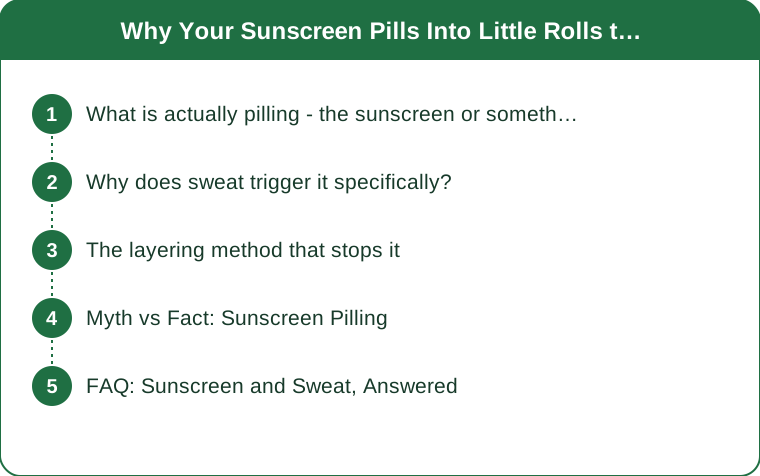
What is actually pilling - the sunscreen or something under it?
Pilling is a film failure, not a product failure. Those little rolls are layers of product that never bonded to each other, lifted by friction into visible balls. They contain sunscreen, but the incompatibility usually starts underneath.
The most common culprit is a base mismatch. Silicones (ingredients ending in -cone or -siloxane) form a smooth, hydrophobic film. Water-based products applied on top of that film cannot penetrate or bond to it - they sit there waiting to be rubbed into rolls.
Film-forming polymers make it worse. Many modern sunscreens use polymers to improve water resistance, and those same polymers are excellent at forming a discrete layer that shears off cleanly when disturbed.
Chemical exfoliants and certain actives underneath change surface pH and texture, which can prevent the layer above from spreading evenly. This is a common cause when the routine is new and the sunscreen is the same one you have always used.
Dead skin buildup contributes independently. A rough, flaking surface gives product nothing consistent to sit on, and the resulting film is patchy and shear-prone from the start.
And too much product is genuinely a cause. Sunscreen needs a certain quantity to reach its labelled protection, but each additional layer beyond a properly spread single application is a layer that has nothing to bond to.
Why does sweat trigger it specifically?
Sweat introduces water to a film that was only marginally stable. Water-based sunscreen that never fully bonded rehydrates and loosens, and the boundary between layers becomes a slip plane.
Friction is the actual mechanic. You wipe your forehead, adjust a headband, push back hair - and each pass shears the loose film into rolls. Without friction, an unbonded film often survives; sweat plus hands is what converts it.
Heat lowers the viscosity of most formulas. A sunscreen that sat as a firm film at room temperature becomes softer and more mobile at skin temperature during exercise, which makes shearing easier.
Salt in sweat interacts with certain emulsifiers, destabilising emulsions that were holding together fine on a still face. This is part of why the same product behaves differently on a run than on a commute.
Sebum production rises during exercise too, adding another mobile phase between your skin and the product film.
And the timing gives it away. Pilling that appears within the first five minutes of sweating is almost always a layering issue. Pilling that appears at forty minutes is more likely a wear-and-friction issue, and the fix is reapplication rather than reformulation.

The layering method that stops it
Match your bases. Check whether your moisturiser and your sunscreen are water-based or silicone-based, and keep them consistent. If your moisturiser lists dimethicone high in the ingredients, pair it with a silicone-containing sunscreen rather than a watery gel one.
Wait ninety seconds between layers. This is the highest-return change and it costs nothing. Each layer needs to set before the next disturbs it, and ninety seconds is enough for most formulas.
Press, do not rub. Apply sunscreen by patting and pressing it into the skin in sections rather than spreading it across the whole face in circles. Rubbing is the same mechanical action that causes pilling later.
Apply in two thin passes rather than one thick one, with a pause between them. You get the required quantity without a single heavy film that shears as a unit.
Simplify before an outdoor session. For training specifically, sunscreen on bare, clean skin - or sunscreen over a very light hydrating layer - pills far less than sunscreen at the end of a five-step routine.
Exfoliate gently twice a week, not the morning of. A smooth surface holds product evenly, but freshly exfoliated skin is more sensitive to both the sun and the formula.
And give it a full ten to fifteen minutes before you sweat. Sunscreen needs time to form its film regardless of type, and starting a warm-up two minutes after application is asking a wet layer to survive friction.
Myth vs Fact: Sunscreen Pilling
Myth: Pilling means the sunscreen is low quality. Fact: pilling is nearly always an interaction between layers. The same sunscreen that pills over one moisturiser applies flawlessly over another or over bare skin.
Myth: You should rub harder to work it in. Fact: rubbing is the mechanical shear that creates the rolls. Press and pat in sections instead, and let each pass set.
Myth: Mineral sunscreens pill more than chemical ones. Fact: both pill, for the same reason. Mineral formulas often contain more film-forming ingredients, which makes the failure more visible, but the cause is compatibility rather than filter type.
Myth: If it pills you can just rub it away and you are still protected. Fact: the rolls are the product. Whatever you wipe off is protection you no longer have, and the area underneath is effectively unprotected.
Myth: Waiting longer between layers is unnecessary fuss. Fact: ninety seconds between layers is the single most effective fix in this list and it is entirely free.
Myth: More sunscreen is always safer. Fact: you need enough to reach the labelled protection, applied properly. Piling on additional layers over an unset film creates shear planes and can end with less product on your face than a single correct application.
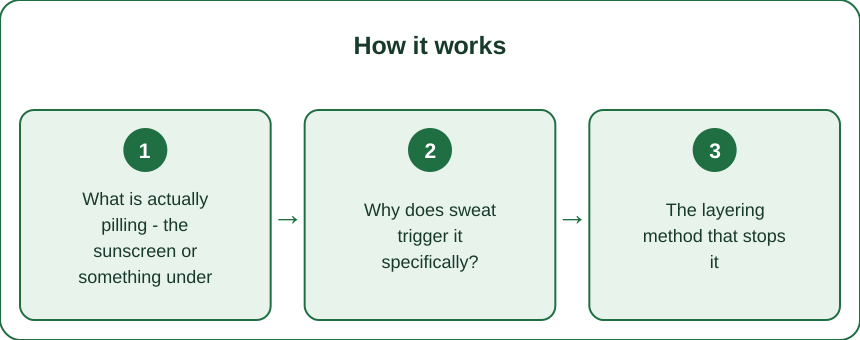
FAQ: Sunscreen and Sweat, Answered
Why does my sunscreen pill only when I work out?
Sweat rehydrates a film that never fully bonded, heat softens it, and friction from your hands and headband shears it into rolls. The instability was there before you started; sweat exposed it.
How do I know if my products are compatible?
Check for ingredients ending in -cone or -siloxane. Silicone-heavy products and water-based products layered together are the classic mismatch. Keep the bases consistent in either direction.
How long should I wait between skincare and sunscreen?
Ninety seconds between layers, and ten to fifteen minutes before sweating. This alone resolves a large share of pilling cases.
Should I skip moisturiser before an outdoor workout?
Simplifying helps. Sunscreen on clean skin or over one light hydrating layer pills far less than sunscreen at the end of a long routine. Save the full routine for non-training days.
Is a pilled area still protected?
No. The rolls are the sunscreen, and wiping them away leaves that area effectively unprotected. Reapply rather than assuming coverage held.
Does a stick or spray sunscreen avoid the problem?
Sticks pill less because you are pressing rather than spreading, which makes them a practical choice for reapplication mid-session. Sprays are difficult to apply at the right quantity, so use them for topping up rather than as the base layer.
TL;DR:
- Pilling is a layering failure, not a sunscreen quality problem - usually a silicone and water-based mismatch.
- Sweat triggers it by rehydrating and softening an already-unbonded film; friction from hands and headbands does the actual shearing.
- Match bases, wait ninety seconds between layers, and press rather than rub.
- Apply in two thin passes and give it ten to fifteen minutes before you start sweating.
- Whatever pills off is protection you no longer have - reapply rather than wiping and carrying on.
Simplify the routine on training days and most of this problem disappears on its own.
Keep Reading
This article is for general informational and styling purposes only. Fit, sizing, and product availability may vary.