Why Your Lips Crack After Training Indoors
Quick Answer: Lips have no oil glands and a very thin barrier, so they lose water faster than any other skin on your body and cannot replace it. Training indoors adds four insults at once: mouth breathing under effort, dry heated air, fluid loss through sweat, and lip licking, which evaporates and takes more moisture with it. The fix is a thick occlusive balm applied before training, not after, plus breathing through your nose when the intensity allows. Avoid balms with menthol, camphor, phenol, or strong flavour - they feel soothing and they make the cycle worse.
This becomes a genuine problem right about now, because heating season is when indoor air goes from humid to bone dry.

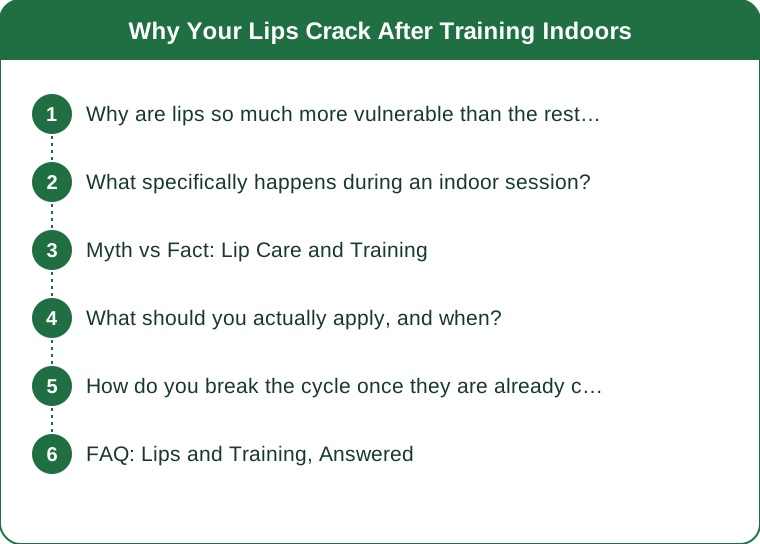
Why are lips so much more vulnerable than the rest of your face?
Structurally, they are a different kind of skin, and every difference works against them.
No sebaceous glands. The rest of your face produces oil that forms a natural barrier and slows water loss. Lips produce none at all - whatever is on them came from outside.
A far thinner stratum corneum. The outermost protective layer on lips is a fraction of the thickness it is elsewhere. Water passes out through it several times faster than through cheek skin.
No melanin to speak of, which is why lips burn easily and why sun damage shows there early. Outdoor training makes this worse; indoor training does not.
They move constantly. Talking, drinking, breathing under exertion. A crack that would heal on a static area gets reopened repeatedly.
And there is no sweat gland cooling or hydrating them. Sweat, whatever else it does, adds surface moisture to the rest of your face. Lips get none of it.
Add all of that together and the picture is clear: lips are the least defended skin on your body, and a gym is one of the more hostile environments they encounter.
What specifically happens during an indoor session?
Four mechanisms, and they compound.
Mouth breathing is the biggest one. Above roughly 70% of maximum effort, nearly everyone switches from nasal to mouth breathing. A continuous stream of air across the lips for forty minutes is a drying process - the same reason your mouth feels parched after intervals.
Heated indoor air is very dry. Heating warms air without adding moisture, so relative humidity in a heated gym in winter can drop to 20-30% compared to 50-60% in summer. Dry air pulls water out of anything exposed to it, and lips have no defence.
Systemic fluid loss. You are sweating, and the body prioritises. Lips are among the first places dehydration becomes visible, which is why they are a reasonable rough indicator of your hydration status.
Lip licking. The reflex response, and genuinely counterproductive. Saliva evaporates quickly and takes surface moisture with it, and it contains digestive enzymes that irritate already-compromised skin. This is the mechanism behind lip lick dermatitis - the ring of irritated skin just outside the lip border.
Bonus insult: a hard water bottle rim, repeated contact with a towel, and in cold months, going outside into cold wind immediately afterwards.
Myth vs Fact: Lip Care and Training
Myth: Drinking more water fixes chapped lips. Fact: Dehydration contributes, but you cannot hydrate lips from the inside past a certain point because there is no barrier holding the moisture in. You need an occlusive on top. Water plus balm works; water alone does not.
Myth: Lip balm is addictive. Fact: Not chemically. What is real is that balms containing menthol, camphor, phenol, or salicylic acid create a cycle - they irritate, the irritation feels like dryness, you reapply. The balm is the problem, not the habit. Switch to a plain occlusive and the compulsion disappears.
Myth: Exfoliating chapped lips helps. Fact: On genuinely cracked lips, scrubbing removes the fragile healing layer and restarts the damage. Hydrate and occlude first; exfoliate only once healed, and gently.
Myth: You only need lip SPF in summer. Fact: Lower lips get significant UV exposure year round, and outdoor autumn training with low-angle sun hits them directly. SPF 30 lip balm is worth having if you train outdoors at all.
Myth: If your lips are cracked, it means a vitamin deficiency. Fact: Usually environmental. Persistent cracking specifically at the corners of the mouth can indicate iron, B vitamin, or other issues, or a fungal infection, and that one is worth a doctor’s opinion. This is general information, not medical advice.
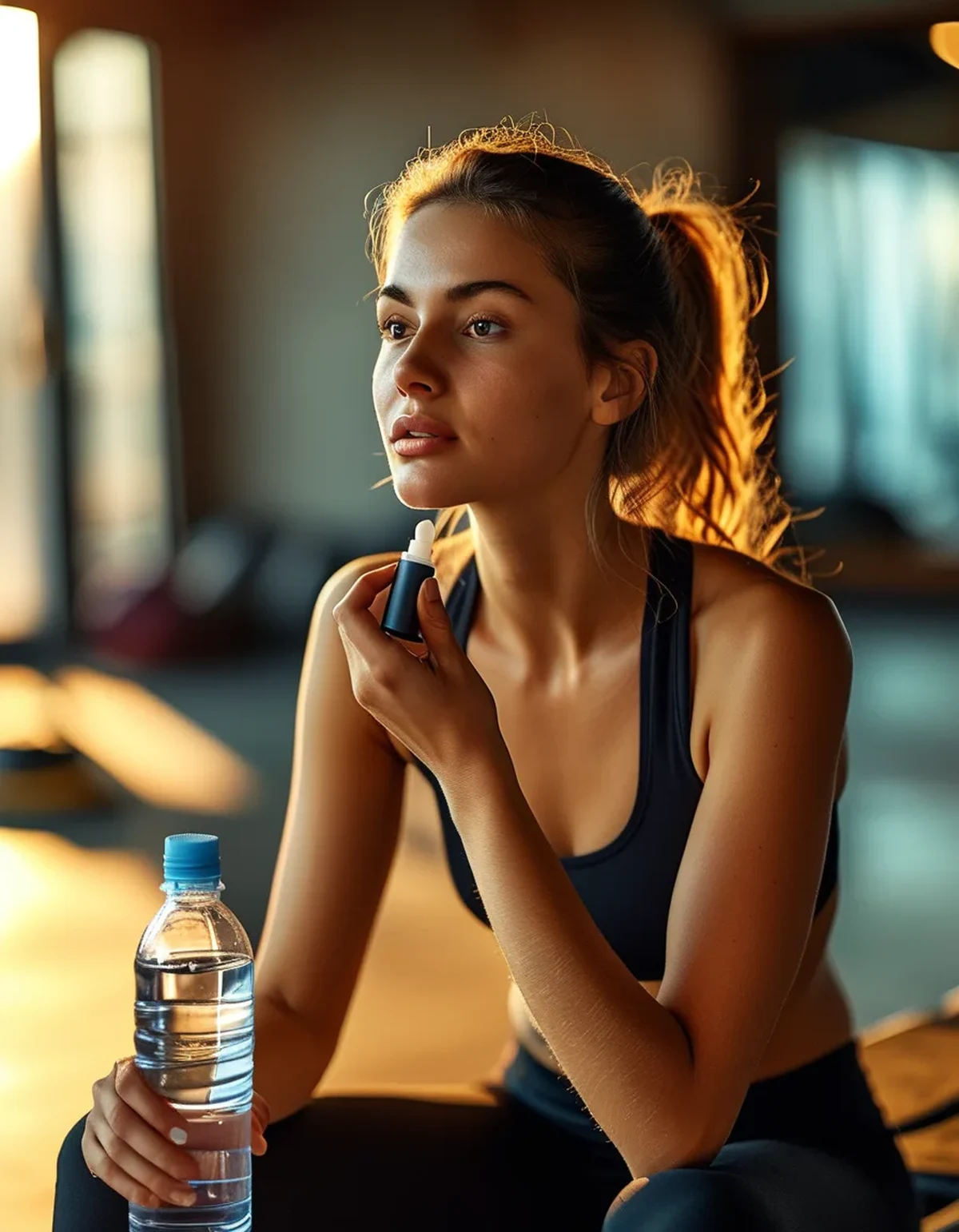
What should you actually apply, and when?
The timing matters as much as the product.
Apply before the workout, generously. This is the change that fixes most cases. A thick occlusive layer applied to clean lips before you start sits there through the session and prevents the water loss rather than treating it afterwards.
Choose an occlusive, not a moisturiser. Petrolatum, lanolin, shea butter, or beeswax. These form a physical barrier that reduces transepidermal water loss. A thin glossy balm that absorbs in five minutes is doing almost nothing.
Ingredients to avoid entirely: menthol, camphor, phenol, salicylic acid, strong flavours and fragrances, and high concentrations of essential oil. All of them provide a cooling sensation that reads as relief and all of them are irritants on compromised skin.
Reapply after training and again at bedtime. Overnight is when repair happens and a thick layer before sleep is the single most effective application of the day.
A humectant underneath helps in very dry conditions. A dab of hyaluronic acid serum or a glycerin-containing product under the occlusive draws water in and the occlusive keeps it there. Humectant alone in dry air can actually pull moisture out of the skin - it needs the layer on top.
For outdoor training, use SPF 30 or higher. The lower lip is exposed and it is a common site for sun damage.
How do you break the cycle once they are already cracked?
Cracked lips need three or four days of deliberate handling, and the main skill is leaving them alone.
Stop licking, consciously. Hardest part, and the one that determines the timeline. Keeping a balm in reach at all times gives you something to do instead, which works better than willpower.
Do not peel flaking skin. Pulling flakes tears the living layer beneath and restarts the damage - and it is how a small crack becomes a bleeding one. Soften with balm and let it come away.
Layer heavily overnight for three nights. Petrolatum or lanolin, thick, every night. Most cases resolve substantially in 48-72 hours with nothing more than this.
Avoid all flavoured and tinted products during recovery. Both are common irritants and tinted products are drying.
Use a humidifier if the room air is very dry. In a heated bedroom in winter this makes a real difference to lips, nose, and eyes together.
Switch to nasal breathing where you can. For easy and moderate work it is entirely possible with a little practice, and it also warms and humidifies the air before it reaches your lungs. At high intensity you will mouth breathe and that is fine - just apply balm beforehand.
See a professional if: cracking persists beyond two weeks of proper care, the corners of your mouth split repeatedly, there is bleeding, swelling, or crusting, or a single patch is rough and does not heal. That last one specifically is worth having looked at. This is general information, not medical advice.
FAQ: Lips and Training, Answered
Why does it start in autumn?
Heating season. Relative indoor humidity drops sharply once heating comes on, often from 50% down to 20-30%, and lips are the first thing to notice.
Is a lip scrub ever a good idea?
On healthy, slightly flaky lips, occasionally and gently. Never on cracked or split lips.
Does my water bottle matter?
A little - a hard plastic or metal rim repeatedly pressed against dry lips can worsen splits. A wide opening you drink from without contact is gentler.
Does mouth taping help?
For sleep, some people find it helps nasal breathing and dry mouth. It is not appropriate during exercise - you need the mouth airway at intensity.
Do I need a separate product for day and night?
Not necessarily, but a thicker, unflavoured ointment at night and something more wearable during the day is the practical setup for most people.
Can pre-workout supplements dry my lips?
Caffeine has a mild diuretic effect and some people report flushing and dryness. More likely, it is the harder session that follows.
TL;DR:
- Lips have no oil glands and a very thin barrier - they lose water fast and cannot replace it.
- Indoor training adds mouth breathing, dry heated air, fluid loss, and lip licking, all at once.
- Apply a thick occlusive before the workout, not after. Petrolatum, lanolin, shea, or beeswax.
- Avoid menthol, camphor, phenol, and strong flavours - they feel soothing and drive the cycle.
- Cracked lips: stop licking, do not peel, layer heavily for three nights. Most resolve in 48-72 hours.
- SPF 30 for outdoor training, and a humidifier once heating starts.
It is a small problem that gets treated with the wrong product by almost everyone. Change the timing and the ingredient list, and it usually stops being a problem at all.
Keep Reading
This article is for general informational and styling purposes only. Fit, sizing, and product availability may vary.