Why Your Skin Stings and Burns After a Sweaty Workout
Quick Answer: Post-workout stinging usually comes from one of four things: sweat’s salt content sitting on a compromised barrier, friction from wiping and equipment contact, a reaction to an active ingredient applied too soon after training, or exercise-induced flushing from increased blood flow. Most cases resolve by rinsing with lukewarm water promptly, patting rather than wiping, and waiting 20 to 30 minutes before applying anything with actives.
The common thread is that skin is temporarily more permeable right after training, and everything you put on it lands harder.

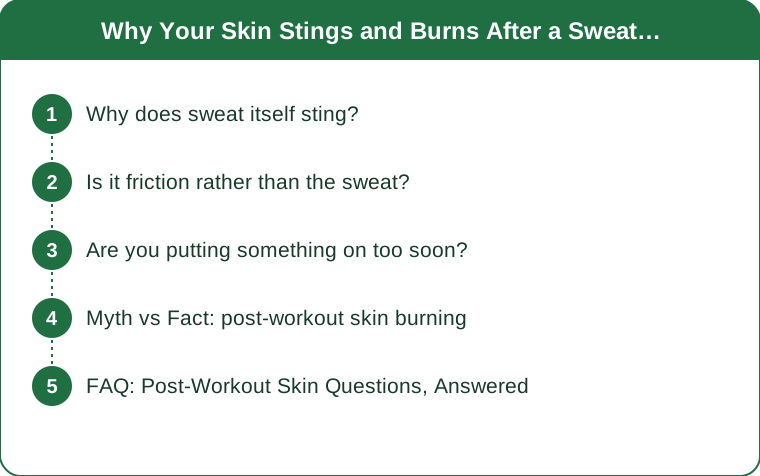
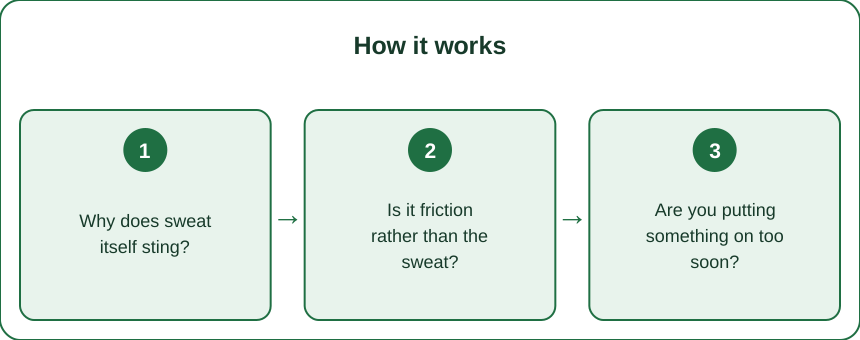
Why does sweat itself sting?
Because of what is in it and what it does to a weakened barrier.
Sweat is salty and slightly acidic. As water evaporates, the salt concentration on the skin surface rises. On intact skin this is harmless. On skin with any barrier compromise — micro-cracks, over-exfoliation, eczema-prone areas, a fresh shave — concentrated salt reaching the layers below produces a genuine stinging sensation.
Sweat sitting on skin also raises surface pH. Healthy skin sits around a pH of 4.7 to 5.75. Prolonged sweat exposure shifts it upward, which reduces the effectiveness of barrier enzymes and the skin’s natural antimicrobial defenses. That is a slow effect but it explains why chronic post-workout stinging tends to worsen over weeks if nothing changes.
Where it stings first tells you where your barrier is weakest. Around the nostrils and mouth, in the eyebrows, along a recently shaved area, or anywhere you have been using an active. Those spots sting before the rest of the face does.
The fix: rinse promptly with lukewarm water — not hot — and do not let sweat dry on the skin. If you cannot shower, a plain water rinse or a gentle micellar wipe is far better than nothing.
Is it friction rather than the sweat?
Very often, and this is the cause people most consistently misattribute.
Towel wiping is abrasive. Repeatedly dragging a towel across the same area during a workout — the forehead especially — creates mechanical irritation that presents exactly like a chemical sting. Gym towels are usually rougher than bathroom towels, and a shared or reused one adds a hygiene dimension.
Equipment contact. Face against a mat, hands on the face, a headband edge, a hood or a strap. Anything with sustained contact plus sweat plus movement is a friction site.
Hands are the biggest offender. Touching your face during a workout transfers everything from the equipment and creates friction at the same time. It is the single most impactful habit to change.
How to tell friction from sweat: friction irritation is localized to contact areas and often slightly raised or pink in a defined pattern. Sweat stinging is diffuse and follows the areas where your barrier is weakest.
The fix: pat, never wipe. Use a clean, soft towel each session — a small stack of face-specific microfiber cloths costs little and lasts. And keep hands off the face, which is easier if you carry a small towel specifically to blot with.

Are you putting something on too soon?
This is the cause that produces the most severe stinging and the most confusion.
Skin is more permeable immediately after exercise. Increased blood flow, elevated skin temperature, open sweat ducts and a hydrated stratum corneum all increase absorption. A product that is comfortable in the morning can genuinely burn 10 minutes after a hard session.
The worst offenders post-workout:
- Vitamin C serums, particularly L-ascorbic acid at higher concentrations
- AHAs and BHAs
- Retinoids
- Alcohol-heavy toners
- Benzoyl peroxide
- Fragranced products of any kind
The rule: wait 20 to 30 minutes after training before applying anything active. Cleanse gently, apply a plain moisturizer if you need one, and save the actives for later or for a different time of day.
Better still, restructure. If you train in the evening, move your actives to the morning. If you train in the morning, use them at night. Separating the two by hours rather than minutes eliminates the problem entirely.
Sunscreen is the exception you should not skip if you are going outside — but choose a mineral formula, which stings far less on compromised skin than many chemical filters do.
Myth vs Fact: post-workout skin burning
Myth: Stinging means the product is working.
Fact: Stinging means your barrier is letting something through that it normally would not. It is a signal to stop, not a sign of efficacy. The idea that discomfort equals results has caused a lot of unnecessary irritation.
Myth: You should wash your face immediately with a strong cleanser after training.
Fact: A gentle, low-foaming cleanser or even plain water is better. A strong sulfate cleanser on already-compromised post-workout skin adds to the problem. The urgency is about removing the sweat, not about how thoroughly you strip.
Myth: The redness and heat mean inflammation you should treat.
Fact: Exercise-induced flushing is a normal vascular response to increased blood flow and elevated core temperature, and it typically resolves within 20 to 40 minutes. It is not the same as inflammatory irritation, though the two can happen together.
Myth: If it stings you should tolerate it and your skin will adapt.
Fact: Repeated barrier disruption does not produce tolerance, it produces a chronically compromised barrier. If a routine stings every session, the routine needs changing.
One thing worth flagging: if the burning is accompanied by hives, welts, swelling, wheezing or dizziness, that is not ordinary post-workout stinging. Exercise-induced urticaria and related conditions exist and warrant medical assessment. This is general information, not medical advice.
FAQ: Post-Workout Skin Questions, Answered
Should I shower immediately after every workout?
Promptly, yes — within about 20 to 30 minutes is a reasonable target, and lukewarm rather than hot. Sitting in sweaty clothes is a bigger driver of body breakouts than facial issues, but both benefit. If you cannot shower, change clothes and rinse your face.
Does wearing makeup to the gym cause this?
It can contribute. Makeup plus sweat plus friction is more occlusive than any of those alone, and it traps sweat against the skin. If you prefer to wear something, a tinted mineral SPF is far more forgiving than full foundation.
What is the simplest routine that avoids all of this?
Rinse or cleanse gently within half an hour, pat dry, apply a plain ceramide or niacinamide moisturizer, and stop there. Do the rest of your routine at the other end of the day.
TL;DR:
- Sweat’s rising salt concentration stings wherever your barrier is already weak.
- Towel wiping, equipment contact and touching your face create friction irritation that mimics chemical stinging.
- Skin is more permeable right after training — wait 20 to 30 minutes before any active, or move actives to the other end of the day.
- Rinse lukewarm within half an hour, pat dry, and use a plain barrier moisturizer.
- Hives, swelling or breathing symptoms are a different problem and need medical assessment.
The skin is not being dramatic. It is more permeable, more abraded and saltier than usual, and all three are easy to work around.
Keep Reading
This article is for general informational and styling purposes only. Fit, sizing, and product availability may vary.