Why Your Skin Looks Better the Day After a Hard Workout
Quick Answer: The immediate red flush after training is vasodilation and fades within about half an hour. What people notice the next morning is different, and likely comes from improved sleep quality, reduced overnight fluid retention, lowered stress hormones and increased circulation — plus a genuinely useful skin routine that most people follow after a workout and skip on other days. It is a real effect, and most of the mechanism is indirect.
The mirror after a session shows a red face. The mirror the following morning shows something better and harder to describe.
Here is what is plausibly going on, and how to get more of it.

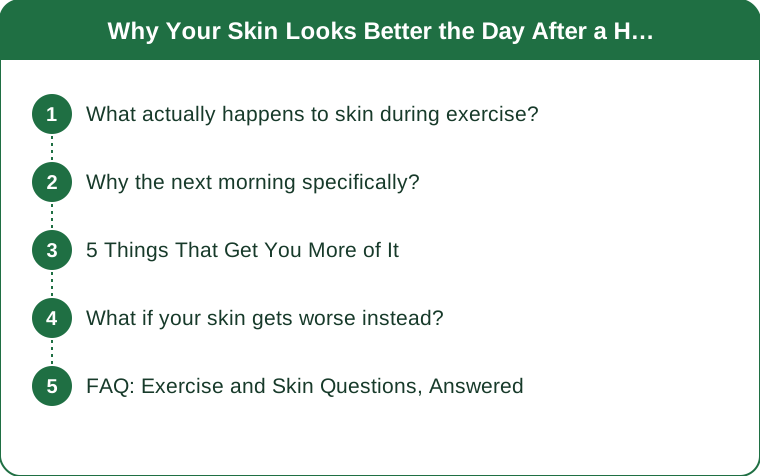
What actually happens to skin during exercise?
Several things, most of which are short-lived.
Blood flow to the skin rises sharply. During exercise your body needs to dump heat, and one of the main routes is dilating the blood vessels near the skin’s surface. That is the flush — more blood closer to the surface, delivering oxygen and nutrients while carrying heat away. It is real, it is visible, and it fades within roughly 20 to 30 minutes of stopping.
Sweat clears the pore opening mechanically and delivers a small amount of moisture to the skin surface. Sweat itself is not a cleanser and does not detoxify anything — that is the liver and kidneys’ job — but the flushing action is not nothing.
Cortisol goes up acutely. Exercise is a stressor and cortisol rises during and immediately after. It comes back down afterwards, and in people who train regularly, resting cortisol and stress reactivity tend to be lower overall. The acute rise is why skin does not look its best immediately after a hard session for everyone.
Inflammation rises temporarily too, particularly after unaccustomed or very hard training. For some people this shows up as post-exercise redness that takes longer to settle, and for those with rosacea it can be a genuine trigger.
So the immediate picture is mixed. Some good, some transient stress. The next-day picture is where the benefits collect.
Why the next morning specifically?
Because most of the mechanisms operate overnight, and several of them compound.
Sleep quality improves, and skin repairs during sleep. Regular exercise is one of the more consistently supported interventions for sleep quality, particularly for the deeper stages. Skin cell turnover, barrier repair and growth hormone release all peak during deep sleep. Better sleep after a hard session plausibly means better overnight repair, and it is the single most likely explanation for the next-morning effect.
Fluid redistributes overnight. Facial puffiness in the morning comes largely from fluid pooling while lying flat. Exercise improves circulation and lymphatic movement, and a day with hard training often means better fluid handling overnight and less morning puffiness — which reads as sharper facial definition.
Stress hormones fall. The acute cortisol rise resolves and, over a night, tends to land lower than baseline for many people. Cortisol is linked to increased sebum production, impaired barrier function and inflammation, so a genuinely lower-stress night plausibly shows on skin.
Circulation stays modestly elevated for hours. Not dramatically, but enough that nutrient delivery and waste clearance in the skin are supported through the recovery window.
You almost certainly drank more water. Hydration status affects skin’s appearance, and a training day usually involves substantially more fluid intake than a rest day. This is unglamorous and probably accounts for a fair share of the effect.
And you washed your face. Almost everyone showers and cleanses after training, often with a proper routine afterward, and many people do less of that on a day they did not train. Part of the next-day glow is simply a good skin day that happened to follow a workout.

5 Things That Get You More of It
1. Shower within a reasonable window, and use lukewarm water. Sweat left sitting on skin for hours, particularly under tight clothing, encourages irritation and breakouts. But very hot water strips the barrier, and stripping the barrier after training undoes a good part of the benefit. Warm, brief, and a gentle cleanser is the version that works.
2. Do not over-cleanse. The instinct after a sweaty session is a strong foaming cleanser and an exfoliating acid. Skin post-exercise is warm, slightly more permeable and mildly inflamed, and that is exactly when harsh actives sting and irritate. Save retinoids and strong acids for non-training evenings or leave a gap of a few hours.
3. Moisturise while skin is still slightly damp. Applying moisturiser within a few minutes of towelling off traps water in the skin and improves the result substantially over the same product on dry skin. This is the cheapest upgrade available.
4. Protect the sleep, not just the session. Since sleep is doing most of the work, a hard evening session that leaves you too wired to sleep is a net negative for skin. If evening training disrupts your sleep, moving it earlier is a skin intervention as much as a training one.
5. Keep the equipment clean. Sweaty headbands, gym towels, phone screens and unwashed pillowcases all reintroduce what you just washed off. The pillowcase in particular gets eight hours of contact with a freshly cleansed face, and changing it more often is one of the higher-value habits nobody talks about.
What if your skin gets worse instead?
Fairly common, and usually attributable to a specific and fixable cause.
Friction plus sweat plus occlusion causes breakouts. Tight sports bras, high-necked tops, hats, headbands and gym equipment against skin create the classic mechanical acne pattern — breakouts exactly where something pressed. The location tells you the cause. Looser or more breathable kit at those contact points is the fix.
Makeup during training is a genuine problem. Foundation over pores that are actively sweating traps sweat and sebum. If you train in makeup, at minimum remove it before rather than after.
Delayed showering matters more than people think. An hour or two in damp clothes, particularly for the back and chest, is a reliable route to body breakouts. If you cannot shower immediately, changing out of the wet layer is a large fraction of the benefit.
Very hard training raises inflammation. If your skin flares specifically after your hardest sessions and settles on easier weeks, that is a plausible overtraining signal worth noticing alongside sleep quality, mood and performance.
Rosacea has a well-recognised exercise trigger via heat and flushing. Cooler environments, a fan, keeping a cold drink to hand, and breaking a long session into segments all help, and it does not mean you should stop training.
Chlorine and hard water strip the barrier. Swimmers and people in hard-water areas often find skin worsens with more training, and the cause is the water rather than the exercise. Rinsing promptly and moisturising immediately addresses most of it.
And the seasonal factor is arriving now. Training indoors in heated, dry air, plus hotter showers, plus more layers against the skin, means the barrier takes a hit through autumn. If your skin was fine all summer and is suddenly reactive in October, look at ambient humidity and shower temperature before changing products.
If you have persistent, painful or scarring breakouts, that is worth seeing a dermatologist about. This is general information, not medical advice.
FAQ: Exercise and Skin Questions, Answered
Does sweating detoxify skin?
No. Detoxification is done by the liver and kidneys. Sweat is thermoregulation, and its skin benefit is limited to mechanically flushing the pore opening and adding brief surface moisture.
Is the post-workout glow just redness?
The immediate glow is largely vasodilation and fades in half an hour. The next-day version is different and probably comes from sleep, hydration, reduced stress hormones and fluid redistribution.
Should I cleanse before working out too?
If you are wearing makeup or heavy sunscreen, yes. Otherwise a splash of water is enough — cleansing twice around a session tends to strip more than it helps.
Does exercise help with acne?
Indirectly and modestly, through stress reduction, better sleep and improved insulin sensitivity, all of which are relevant to acne. It can also worsen it through friction and sweat if kit and washing habits are wrong. Net effect depends on the details.
Does it help with ageing?
Regular exercise is associated with better skin quality in observational research, plausibly through circulation, sleep, stress and metabolic health. It is not an anti-ageing treatment, and sun protection remains far and away the highest-impact thing you can do.
How soon should I shower?
Sooner is better, but there is no cliff edge. Getting out of damp clothing promptly does most of the work if a shower is not immediately available.
TL;DR:
- The immediate flush is vasodilation and fades in about half an hour. That is not the effect people mean.
- The next-morning version likely comes from better sleep, less fluid retention, lower stress hormones and more water.
- Part of it is simply that you washed your face and moisturised — a good skin day that followed a workout.
- Warm not hot water, gentle cleanser, moisturise while damp, and save strong actives for non-training evenings.
- Breakouts after training are usually friction plus occlusion. The location tells you which item to change.
Change your pillowcase more often. It gets eight hours against a freshly cleansed face and nobody thinks about it.
Keep Reading
This article is for general informational and styling purposes only. Fit, sizing, and product availability may vary.