Sunscreen and Sweat: Why Outdoor Workouts Break You Out and Indoor Ones Don't
Quick Answer: Sunscreen rarely causes workout breakouts on its own. The breakouts come from sunscreen sitting under sweat for 60+ minutes, being reapplied over a sweaty face, or being removed with a single water rinse instead of a cleanser. Use a fluid or gel sunscreen, apply it 15 minutes before you start, blot rather than wipe, and double-cleanse within 30 minutes of finishing. Skipping sunscreen is a much worse trade for your skin than the occasional spot.
Your indoor sessions are fine. Six weeks of outdoor training and your jawline looks like it did in high school.
The easy conclusion is that the sunscreen did it, so you stop wearing it — which solves a small problem by creating a permanent one.
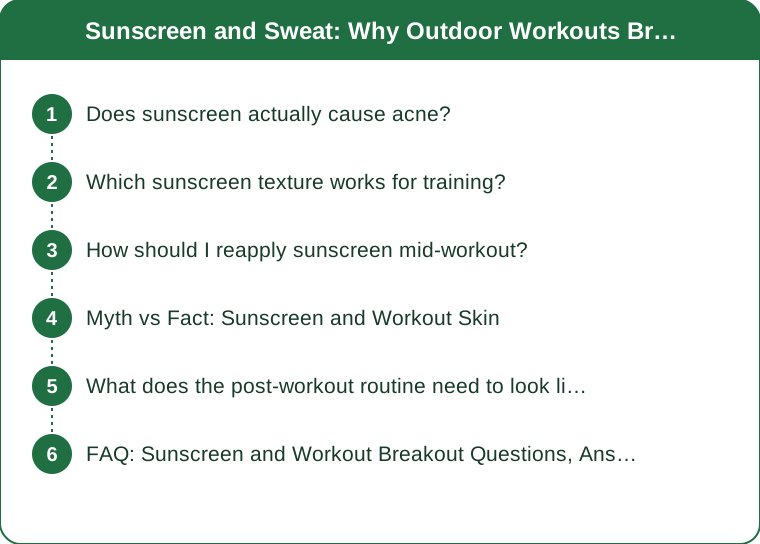
Does sunscreen actually cause acne?
Sunscreen itself is a weak acne trigger. Sunscreen plus sweat plus time is a strong one.
Modern filters are not the issue for most people. The comedogenic reputation sunscreen carries comes largely from older, heavier formulations built around thick occlusive bases — the kind that made sense for a beach chair and make no sense for a tempo run.
What changes the math is duration. A film of product that would be harmless for twenty minutes becomes a problem when it sits mixed with sweat, sebum, and dust for ninety minutes at skin temperature. That mixture is thicker, stickier, and far more likely to stay lodged in a pore than either substance alone.
The second factor is friction. Wiping a sweaty, sunscreened face with a shirt hem or a gym towel drags the product sideways into pores rather than off the skin. Blotting removes; wiping relocates.
And the third is what happens after. Rinsing with water removes sweat and salt. It does not remove a water-resistant sunscreen, which is engineered specifically to survive water. That leftover film then spends the evening on your face.
Which sunscreen texture works for training?
Fluid, gel, and ‘sport’ lotion formats outperform cream sunscreens for anyone who sweats in them — not because they protect better, but because they sit thinner.
Look for the words fluid, gel, serum, or water-light. These are usually alcohol-containing or silicone-heavy bases that set quickly and stay put without building a heavy layer.
Mineral vs chemical matters less than texture. A light chemical fluid and a light mineral fluid both behave well; a heavy version of either behaves badly. Zinc-based sunscreens do have a mild anti-inflammatory edge for reactive skin, which is worth trying if your skin is more irritable than oily.
Avoid anything marketed as ‘nourishing’, ‘glow’, or ‘dewy’ for training. Those words describe emollients, and emollients are exactly what you don’t want under an hour of sweat.
Water-resistant ratings are 40 or 80 minutes, and that number is measured in water, not sweat. For a session longer than the rating, plan a reapplication — done correctly, which is the next section.
Sticks are useful for one job only: touching up nose, ears, and hairline mid-session without dragging product across your whole face.
How should I reapply sunscreen mid-workout?
Never reapply onto a wet face. That single habit causes more breakouts than the sunscreen ever will.
Blot first with a clean, dry cloth — press and lift, do not drag. You are removing the surface sweat layer so the new product has something to bond to.
Then apply, and apply less than you think. A reapplication is not a second full dose; it’s a top-up on the high-exposure zones: nose, cheekbones, ears, the part in your hair, and the back of the neck.
Use a different clean cloth each time. A towel you have already used is loaded with sweat, sebum, and bacteria, and pressing it to your face is a direct transfer.
If the session is under an hour and you’re not swimming, skip the reapplication entirely. One good application at the start, absorbed for fifteen minutes before you move, protects a one-hour run adequately and gives your pores far less to deal with.
The timing detail nobody mentions: sunscreen needs about 15 minutes to set before sweat hits it. Applying at the trailhead and starting immediately means half of it ends up on your collar.

Myth vs Fact: Sunscreen and Workout Skin
Myth: If you break out from sunscreen, you’re allergic to it. Fact: True allergy to sunscreen filters is uncommon. Most reactions are either irritation from fragrance and alcohol, or occlusion from a formula too heavy for sweaty conditions. Changing texture solves it far more often than changing filter type.
Myth: A tinted sunscreen is basically makeup and will make things worse. Fact: The iron oxides that provide the tint are among the least reactive pigments in cosmetics, and they add visible-light protection that matters for pigmentation. A tinted fluid is usually lighter than a full-coverage foundation you’d wear instead.
Myth: You don’t need sunscreen at 6am. Fact: UVA is present across daylight hours and passes through cloud cover. A 6am summer run in an open park is real exposure, even without the sunburn feedback that UVB gives you.
Myth: Sweat washes sunscreen off, so it stops working — but also stays in your pores. Fact: Both can be true at once, which is the whole problem. The film degrades as protection while persisting as residue. That’s why removal matters as much as reapplication.
Myth: SPF 50 is twice the protection of SPF 25. Fact: SPF 25 blocks about 96% of UVB, SPF 50 about 98%. The bigger variable is how much you apply — most people use a third of the tested amount, which drops real-world SPF dramatically.
What does the post-workout routine need to look like?
Cleanse within 30 minutes of finishing, and use two steps if you wore a water-resistant sunscreen.
Step one is an oil cleanser, micellar water, or a cleansing balm. Sunscreen filters are lipid-soluble; oil dissolves them in a way that a foaming face wash simply cannot. Thirty seconds of massaging, not five.
Step two is a gentle gel or cream cleanser to remove the oil, the sweat salt, and anything the first step loosened. Lukewarm water — hot water on already-flushed post-workout skin drives redness.
Then stop. No toner, no acid, no scrub in the same sitting. Post-exercise skin is warm, dilated, and mildly compromised in barrier function for about 20 to 30 minutes, and layering actives into that window is how a mild breakout becomes an irritated one.
Moisturize while damp, even if you’re oily. Skipping moisturizer after a double cleanse is a reliable way to trigger rebound oil production by the next afternoon.
If you can’t shower for an hour — commuting home, a school pickup, an errand — carry two things: a pack of unscented micellar wipes for the face only, and a clean dry cloth. Wiping the sunscreen film off imperfectly beats leaving it on perfectly.
FAQ: Sunscreen and Workout Breakout Questions, Answered
How long after a workout can I wait to wash my face?
Aim for under 30 minutes. The combination of trapped sweat, sunscreen, and warm skin is most problematic in the first hour. If a shower isn’t possible, cleanse the face separately and shower later.
Should I use a physical or chemical sunscreen for exercise?
Whichever one comes in the lightest texture you’ll actually reapply. Zinc-based options have a slight edge for reactive or rosacea-prone skin; for oily, acne-prone skin, a light chemical fluid usually feels better and stays put.
Is it better to just wear a hat and skip sunscreen?
A wide brim helps enormously for the forehead and nose and does nothing for the cheeks, jaw, and neck, which catch reflected light off pavement and water. Use both — a hat lets you get away with a lighter application.
Why do I only break out along my hairline and jaw?
Those are the zones where product migrates with sweat and where headbands, caps, and collars create friction. Applying slightly less along the hairline and cleansing those two areas deliberately usually resolves it in two to three weeks.
This is general information, not medical advice. Persistent or painful breakouts are worth a conversation with a dermatologist.
TL;DR: The sunscreen is almost never the problem. The timeline around it is.
- Choose texture over filter type — fluid, gel, or sport formats sit thin enough to survive an hour of sweat.
- Apply 15 minutes before you start, not at the trailhead, so it sets before sweat arrives.
- Blot, never wipe. Wiping relocates product into pores instead of removing it.
- Reapply onto a blotted face only, and only on the high-exposure zones for sessions past the water-resistance rating.
- Double-cleanse within 30 minutes — oil first to dissolve filters, gentle cleanser second.
- Nothing active for 20 to 30 minutes after. Warm, dilated skin is not the place for acids.
Give a new texture three weeks before you judge it. And whatever you conclude, don’t solve a breakout problem by taking off the sunscreen — that trade only looks good for one summer.
Keep Reading
This article is for general informational and styling purposes only. Fit, sizing, and product availability may vary.